Decision Intelligence Working Paper No. 1
Position, Decision, and Speed
A Dynamic Framework for Understanding Organisational Adaptation and Performance
Not peer reviewed. This is a conceptual working paper, published for discussion. It reports no original data, and its propositions have not yet been tested.
Abstract
This paper develops the Position–Decision–Speed (PDS) framework, an integrative conceptual model of organisational performance and adaptation. PDS holds that an organisation’s subsequent performance depends on the interaction of its positional fitness in a market problem space, the quality of the decisions that direct its movement from that position, and the speed with which those decisions are implemented. Strategic position is defined as the organisation’s relative fit with valued customer problems and its differentiation from competing offerings; decision quality as the quality of the information, reasoning, alternatives, assumptions and expected consequences behind consequential choices; and implementation speed as the inverse of the time taken to turn an authorised decision into realised organisational change. Drawing on research into competitive positioning, organisational fitness landscapes, strategic decision processes, dynamic capabilities and innovation management, the paper formalises the framework in three steps: a representation of movement through a multidimensional market problem space, a model in which decision quality and implementation speed shape directed change in positional fitness, and a lagged performance model with main and interaction effects. It distinguishes decision speed, implementation speed and response speed, and rejects the assumption that faster action is invariably beneficial. It also sets PDS against neighbouring frameworks, including the OODA loop, first-mover advantage, Red Queen competition and dynamic capabilities, and identifies predictions that PDS makes and they do not. Seven propositions are developed to guide empirical testing. The paper is conceptual: it reports no original data, and its propositions await empirical validation across industries and organisational contexts.
Keywords: strategic positioning; strategic decision-making; decision quality; implementation speed; dynamic capabilities; organisational adaptation; firm performance; fitness landscapes
Introduction
Explaining why some organisations sustain superior performance while others decline remains a central problem in strategic management. Established perspectives illuminate important parts of this problem. Competitive strategy explains how firms establish distinctive positions and configure activities to create value (Porter, 1996). The resource-based view explains how valuable and difficult-to-imitate resources can support persistent advantage (Barney, 1991). Dynamic capabilities research addresses how firms sense environmental change, seize opportunities and reconfigure resources (Teece, 2007). Behavioural and strategic decision-making research examines how organisational actors choose courses of action under bounded rationality, uncertainty and political constraints, and how quickly they do so (Dean & Sharfman, 1996; Eisenhardt, 1989; Elbanna & Child, 2007). Innovation research, in turn, investigates the conditions under which new offerings are developed and introduced successfully, including the role of development speed (Cankurtaran et al., 2013; Kessler & Chakrabarti, 1996).
These traditions are complementary, yet they are seldom brought together in a single parsimonious framework that links a firm’s market position, the quality of its strategic choices and the speed with which it implements change. This paper proposes such a framework: Position–Decision–Speed (PDS). Its core claim, stated here and used throughout, is that an organisation’s subsequent performance depends on the interaction of its positional fitness in a market problem space, the quality of the decisions that direct its movement from that position, and the speed with which those decisions are implemented.
The framework treats position as a state, decision quality as a directional and evaluative capability, and speed as a temporal property of organisational change. The three are related, but collapsing them loses information. A firm may occupy a favourable position yet fail to adapt; it may make well-reasoned decisions but implement them too slowly; or it may execute rapidly while moving towards a less valuable market position. Because no single dimension is sufficient, the framework concentrates on how the three interact.
The paper makes four intended contributions. First, it integrates market positioning and organisational adaptation by representing the firm’s strategic position as a location within a multidimensional market problem space whose value depends on customer preferences, rival offerings and environmental conditions. Second, it distinguishes the quality of strategic decision processes from realised decision outcomes, which avoids the outcome-bias problem of judging decisions solely by what subsequently happened (Baron & Hershey, 1988). Third, it specifies how implementation speed conditions the conversion of decisions into directed positional change, while recognising that speed has context-dependent benefits and costs. Fourth, it compares PDS with neighbouring frameworks and identifies where its predictions differ from theirs.
The paper is a conceptual, theory-development exercise. Its propositions are derived theoretically and are not presented as established empirical findings. The model is intended to generate testable hypotheses and to support the design of future longitudinal and comparative research.
Theoretical Foundations
Strategic position and the market problem space
Strategic position concerns the value a firm offers to particular customers relative to the alternatives available to them. Positioning cannot be reduced to a single performance indicator such as market share, customer satisfaction or profitability. These measures capture different consequences of a firm’s activities and may diverge over time. A firm can have high current profitability while becoming less relevant to emerging customer needs; another may have low current returns while investing in a position with future potential. A multidimensional account is therefore needed to distinguish current financial outcomes from the underlying configuration of value offered to the market.
Porter (1996) conceptualises strategy as the creation of a unique and valuable position involving a distinctive set of activities and trade-offs. This account matters because it cautions against equating positioning with maximising customer satisfaction on every attribute. A firm must choose which needs to serve, which activities to perform and which trade-offs to accept. Day (1994) similarly emphasises market-sensing and customer-linking capabilities as distinctive features of market-driven organisations. Together, these perspectives support the view that position is relational: it depends on the fit between an organisation’s offering, the needs of selected customers and the alternatives supplied by competitors.
In this paper, the term market problem space (MPS) refers to a conceptual, multidimensional representation of the attributes, outcomes and constraints that define the problems customers seek to solve. Dimensions may include price, reliability, convenience, performance, accessibility, service, risk, sustainability or other attributes relevant to a given market. The dimensions are not assumed to be universal; their meaning and importance vary by industry, customer segment and time. The space is accordingly constructed empirically for a specified market and unit of analysis, and is not treated as a fixed, objectively complete map of all possible customer needs.
A firm’s position within the MPS is represented by a vector of offering attributes. The desirability of that position is not intrinsic to the coordinates themselves. It depends on how well the offering addresses the weighted needs of target customer segments and how it compares with rival offerings. The framework therefore distinguishes a positional vector from a scalar assessment of positional fitness: the former represents where the firm is; the latter estimates how advantageous that position is under specified market conditions.
Organisational fitness landscape research provides a complementary foundation. Levinthal (1997) models organisational adaptation on a rugged landscape in which the effects of organisational attributes are interactive. Because such landscapes have multiple local peaks, a firm’s starting configuration can influence the paths available to it and the peaks it can reach. For PDS, this implies that strategic movement is path-dependent: the consequences of a decision depend partly on the firm’s current configuration and the interdependencies among its activities.
The MPS is nonetheless distinct from an organisational fitness landscape. The MPS represents the customer and competitive dimensions against which an offering is evaluated; a fitness function maps a firm’s position and relevant organisational capabilities onto expected or realised outcomes. Keeping the two apart avoids treating customer preference, competitive position and firm performance as interchangeable constructs.
Strategic decision quality
Strategic decisions allocate substantial resources, establish commitments and shape an organisation’s direction. Their quality is difficult to evaluate because decision-makers operate under uncertainty, incomplete information, bounded rationality and political constraints. Research on strategic decision effectiveness indicates that the link between decision processes and outcomes is context-dependent. Elbanna and Child (2007), for example, identify rationality, intuition and political behaviour as distinct dimensions of strategic decision processes and show that their effects vary with contextual conditions. Dean and Sharfman (1996) likewise find that procedural rationality is related to decision effectiveness, while also highlighting the importance of implementation and environmental favourability.
PDS defines strategic decision quality as the degree to which a consequential decision is supported by an appropriate process, given the decision’s context and the information reasonably available at the time. Relevant process characteristics include the quality and relevance of information, the explicit consideration of alternatives, the articulation of objectives and trade-offs, the evaluation of uncertainty and risk, the inclusion of relevant expertise, and the use of review or updating mechanisms. The definition does not assume that formal analysis always outperforms intuition: the appropriate process depends on the decision, the time available, the environment and the distribution of expertise. To keep “appropriate” from becoming a judgement made after the fact, the paper specifies in advance which process elements are required for which classes of decision (Table 1).
Separating decision quality from realised outcomes is essential. Baron and Hershey (1988) demonstrate outcome bias: people evaluate the quality of a decision differently depending on whether its outcome was favourable, even when the decision-maker had the same information at the time. In organisations, this bias can distort learning, reward systems and post hoc assessments of managerial competence. A favourable outcome does not prove that a decision was well made, and an unfavourable outcome does not by itself prove that it was poorly made. PDS therefore treats decision-process quality as an antecedent construct and subsequent performance as an outcome to be explained.
Decision quality is also distinct from decision effectiveness. Decision quality refers to the merits of the decision process and the ex ante rationale for selecting an alternative. Decision effectiveness refers to the extent to which the selected decision, once implemented, achieves its intended objectives, and it is influenced by implementation quality, environmental change and contingencies beyond the decision-maker’s control. The distinction allows the framework to examine how good decisions can fail during implementation and how apparently poor decisions can benefit from favourable external events.
Finally, strategic decisions are better understood as revisable commitments than as isolated acts. Dynamic capabilities research emphasises the sensing, seizing and reconfiguring activities through which firms respond to changing environments (Teece, 2007). In PDS, decision quality includes the practice of updating assumptions, reconsidering commitments and redirecting resources as new evidence arrives, which matters most where market conditions change faster than formal planning cycles. PDS locates this updating in observable features of the decision process, such as review triggers set at the time of commitment, so that it can be measured separately from the broader sensing capabilities emphasised by dynamic capabilities research.
Implementation speed, innovation speed and response speed
Speed is frequently invoked as a source of competitive advantage, but organisational research distinguishes several forms of it. Decision speed concerns the time required to reach a commitment to act. Implementation speed concerns the time required to execute a decision. Response speed concerns the time required to respond to an external competitive or environmental event. Innovation speed is narrower: it concerns the time required to move an innovation from initiation or conception through development to market introduction. These constructs may be correlated, but they are not interchangeable.
Kessler and Chakrabarti (1996) develop a conceptual model of innovation speed and argue that its value depends on environmental conditions, including competitive intensity and market and technological dynamism. Later meta-analytic work adds further qualifications. Cankurtaran et al. (2013) report that faster development tends, on average, to accompany better new-product results, although the size of that link depends heavily on how success is measured and on the setting studied. Kolev et al. (2025), synthesising 127 studies, treat decision, implementation and response speed separately; each shows a positive average association with firm performance, and the strength of each association differs with the research setting and with how the underlying studies were designed.
Speed is therefore not an unconditional organisational virtue. Accelerating a poorly specified project may increase waste; shortening development time may compromise reliability or safety; and rapid strategic decisions may reduce the time available for consultation or learning. Research on new product development also identifies potential trade-offs among speed, cost and quality (Swink et al., 2006). Conversely, rapid experimentation can shorten feedback loops and enable earlier learning. The relevant theoretical question is when speed improves the conversion of sound strategic choices into valuable outcomes, and not simply whether faster is better.
For PDS, the principal speed construct is implementation speed: the inverse of the elapsed time between the authorisation of a strategic decision and its realisation in the firm’s offering, activities or resource configuration. Innovation speed is one important form of implementation speed, particularly where the strategic change involves product, service or business-model development. Decision speed and response speed are related but distinct constructs that may shape implementation speed and the timing of adaptation. Implementation speed is also kept separate from the amount and direction of the positional movement that results. How quickly a firm acts is a property of its implementation capability; where it ends up is partly an outcome of that action.
The Position–Decision–Speed Framework
Construct definitions and levels of analysis
The framework is designed primarily for analysis at the firm or strategic business-unit level, although its constructs can also be applied to product-market units or major strategic initiatives. The unit of analysis has to be specified before measurement. A diversified corporation may occupy several distinct positions across product markets, and aggregating these into one corporate coordinate can conceal important variation. Where firms operate across multiple segments, the firm-level position is constructed from segment-level positions using an explicit weighting rule, such as revenue, strategic importance or customer population.
Strategic position () is the firm’s relative fit and differentiation in a specified market problem space. It is represented by a positional vector and evaluated by a context-dependent fitness function , where denotes the relevant market and environmental conditions. Decision quality () is the quality of the processes used to select and revise consequential strategic actions. Implementation speed () is the inverse of the elapsed time between authorising a strategic commitment and realising it as organisational change. Directed positional change () is the change in positional fitness produced by the firm’s own repositioning; it is an intermediate outcome through which decision quality and implementation speed are expected to operate. Firm performance () is a specified outcome measured over a subsequent period; it may include financial, market, innovation or survival outcomes, which are not to be combined without a defensible measurement model.
These constructs are not interchangeable indicators of a single latent trait. Position is a market-relative state; decision quality is a process capability; implementation speed is a temporal capability; directed positional change is an intermediate outcome; and performance is a final outcome. In these terms, the core claim of PDS is that an organisation’s subsequent performance depends on the interaction of its positional fitness in a market problem space, the quality of the decisions that direct its movement from that position, and the speed with which those decisions are implemented.
Representing strategic position
Let the strategic position of firm at time be represented by a -dimensional vector:
Each coordinate represents a specified attribute of the firm’s offering or activity system. Because coordinates may have different units, they are standardised or transformed before distances are calculated. Let represent the estimated ideal or required attribute profile for customer segment at time , and let be a positive semi-definite weighting matrix representing the relative importance and covariance of attributes for that segment. A segment-specific distance measure is then:
A lower distance indicates closer fit to the segment’s preference profile, but fit alone does not establish competitive advantage. The offering must also be evaluated against competing alternatives and the economics of serving the segment. A general positional-fitness index can therefore be expressed as:
where is the weight assigned to segment ; captures the firm’s relative value or differentiation compared with relevant rivals; captures the economic and operational feasibility of serving the segment; and is a prespecified scoring function. Equation 3 is a general measurement architecture, not a claim that a single universal functional form exists. The function has to be specified and validated for the market under study, and the index tested for sensitivity to alternative segment weights and scoring functions.
This formulation keeps the spatial intuition that firms occupy locations in a space of customer-relevant attributes, without assuming that all firms can be located in one universal space or that the arithmetic mean of customer preferences marks the optimal position. Segment heterogeneity and strategic trade-offs mean that a firm may rationally prioritise a particular segment instead of maximising average fit across all customers. This is consistent with positioning as a choice among valuable but potentially incompatible alternatives (Porter, 1996).
Representing movement and directed positional change
The firm’s movement through the MPS is represented as a change in its positional vector between observations:
where is the firm’s realised repositioning and captures measurement error and unmodelled change. The magnitude describes how far the firm has moved, but not whether the movement helped. A firm can move a long way towards a less favourable position, or change little while strengthening the fit and defensibility of its existing one. PDS therefore evaluates movement by its effect on positional fitness. Because the fitness function itself shifts as customer preferences and rival offerings change, the change in fitness between and can be decomposed into two parts:
The first term, directed positional change, is the gain or loss in fitness produced by the firm’s own repositioning, evaluated under current conditions. The second term, environmental drift, is the change in the value of an unchanged position. Directed positional change is the outcome through which decision quality and implementation speed are expected to act; environmental drift captures erosion or improvement that occurs whether or not the firm moves.
Representing implementation speed and intended direction
Implementation speed is measured at the level of strategic initiatives. For initiative in firm , let be the elapsed time between formal authorisation and a prespecified realisation milestone, such as operational deployment or market introduction. Implementation speed is the inverse of this duration, aggregated across the initiatives authorised in period :
where the weights reflect each initiative’s resource exposure or strategic significance. Using the inverse ensures that higher values denote faster implementation; a logarithmic form () is an alternative when durations are highly skewed. Speed defined in this way is independent of the size and direction of the resulting change: two firms can implement equally quickly while one moves towards a more valuable position and the other away from it.
Each initiative also has an intended direction. Let denote the target position recorded when initiative is authorised. Its intended positional gain is:
Because is fixed ex ante, it can moderate the effect of speed without conditioning on the outcome that speed is meant to produce.
Representing decision quality
Let denote the quality of strategic decision processes in firm during period . For an individual strategic decision , a decision-quality score can be represented as a weighted composite of process elements:
where is the rating of process element (Table 1) and is a theoretically justified weight. At the firm level, can be estimated by aggregating material decisions, weighted by their resource exposure or strategic significance, so that a trivial operational choice does not count as much as a major market-entry or capital-allocation decision. Equal weights are not assumed by default; they may be developed through validated scales, expert assessment or empirical measurement models. Process indicators are best collected as close as practicable to the time of decision, to reduce retrospective reconstruction and outcome contamination. Decision outcomes can be examined separately as measures of effectiveness, calibration or forecast accuracy.
Table 1 specifies what counts as an appropriate process before any decision is rated. Each decision is first assigned to a tier using criteria fixed in advance: resource exposure, reversibility and the time available. Tier A covers high-exposure or hard-to-reverse decisions; Tier B covers lower-exposure or readily reversible ones. A process is appropriate when it satisfies every element required for its tier. Elements are scored 0 (absent), 1 (partial) or 2 (present) by raters who do not know the outcome. For element 2, the score rates the quality and distinctness of the alternatives considered, not their number: a single option explicitly stress-tested against the status quo can score 2, whereas several near-identical options may not. Alternatives remain an element because the evidence favours them: in a study of 356 decisions by senior managers, Nutt (1999) found that multiple options were developed in fewer than 20 percent of decisions, and that success rates rose from 56 to 70 percent when they were. Under time pressure, the tier rule, and not the rater, determines which elements may be abbreviated, so that lighter processes are neither rewarded nor penalised after the fact. The elements combine the process characteristics set out above with the decision-quality elements described by Spetzler et al. (2016).
| Element | Evidence sought in the decision record | Required for |
|---|---|---|
| 1. Frame and objectives | The decision, its scope and the objectives it serves are stated | Tiers A and B |
| 2. Alternatives | Alternatives proportionate to the stakes, including the status quo, were considered and reasons for rejection recorded; a single option qualifies if stress-tested against the status quo (e.g., by mental simulation or a pre-mortem) | Tiers A and B |
| 3. Information | Evidence is relevant and sourced, and its reliability is noted | Tiers A and B |
| 4. Uncertainty and assumptions | Key assumptions and uncertainties are explicit, with forecasts or ranges where feasible | Tier A |
| 5. Values and trade-offs | Trade-offs among objectives are stated and the chosen balance is justified | Tier A |
| 6. Expertise and challenge | Relevant expertise was consulted and dissent or challenge was recorded | Tier A |
| 7. Reasoning | The choice follows from the stated evidence and objectives | Tiers A and B |
| 8. Commitment and review | An owner, resources and the conditions that would trigger review are set | Tiers A and B |
The checklist has a deliberate scope. Research on naturalistic decision making shows that experienced decision makers under time pressure often recognise a situation as typical, generate a single workable option, test it by mental simulation and act, frequently with good results (Klein, 1998). The checklist is designed for deliberate, consequential decisions. Applied mechanically to fast expert decisions, it could mark them down for lacking a formal comparison of options and so confound decision quality with speed, a risk that matters because implementation speed is a core PDS construct. The stress-tested single-option route in element 2 addresses this, and the tier rule allows time-critical decisions to be assessed against a lighter standard. The tiers, the assignment of elements to them and any weighting are the author’s proposals and remain to be validated.
An integrated performance model
Two equations connect the constructs. The first treats directed positional change as an intermediate outcome of decision quality and implementation speed, given the firm’s starting position:
The second models subsequent performance as a function of the three PDS constructs and their interactions:
where is a specified performance outcome measured periods after the explanatory variables; is a vector of theoretically relevant controls; represents time-invariant firm effects; represents common time effects; and and are idiosyncratic errors. Continuous predictors are centred or standardised before interaction terms are formed, which aids interpretation and reduces non-essential multicollinearity. Adding to Equation 10 separates the part of the effect of and that runs through directed positional change from any direct effect, for example through cost or reliability.
The three-way term reflects the proposition that the value of implementation speed depends jointly on positional fitness and decision quality. Including it makes that joint proposition testable; it does not presuppose a positive coefficient. Nested specifications with and without the three-way term can be compared, and marginal effects reported in preference to raw interaction coefficients.
Linearity in speed is a starting assumption, not a complete representation. Because very high speed may generate coordination costs, quality failures or premature commitments, a quadratic term can be added where theory and data warrant it:
A negative , conditional on the other terms, would be consistent with diminishing or inverted-U returns to speed; the term is not to be imposed without theoretical justification or evidence. Environmental dynamism, technological uncertainty, regulation, organisational slack, interdependence and innovation novelty are plausible moderators.
Proposition 6 concerns the direction of movement and is tested most directly at the initiative level:
where is an initiative-level outcome measured after realisation, such as the initiative’s realised fitness gain or return, and contains initiative and firm controls.
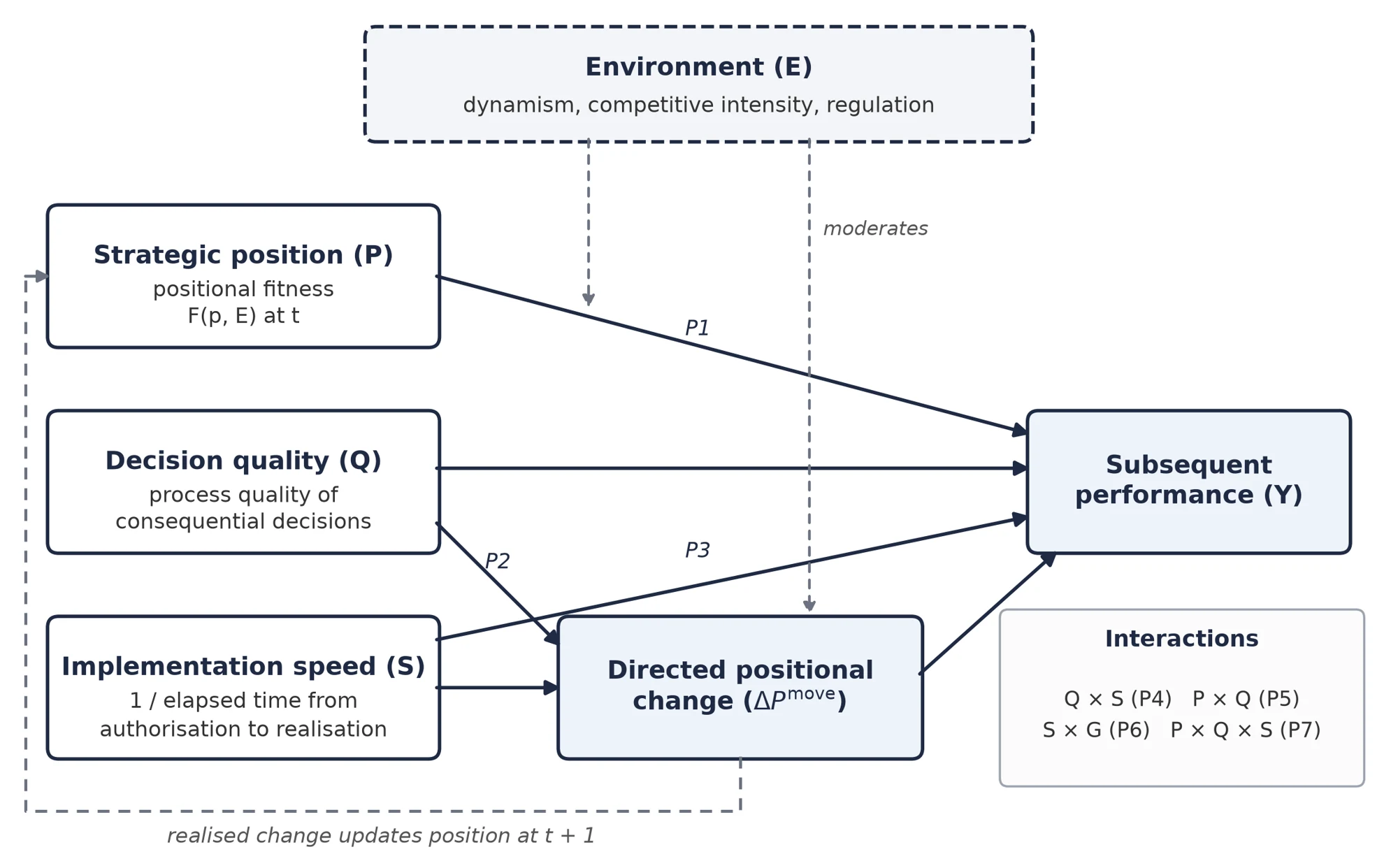
Theoretical Propositions
Proposition 1: Positional fitness and subsequent performance
A firm’s position is valuable to the extent that it aligns with important customer problems, differentiates the offering from relevant alternatives and can be served economically. A favourable position is therefore expected to be associated with stronger subsequent performance, although the strength of the association will depend on the stability of customer preferences, competitive imitation and the firm’s ability to appropriate value.
P1: Greater positional fitness in a specified market problem space will be positively associated with subsequent organisational performance, controlling for relevant firm, industry and time effects.
Proposition 2: Decision quality and directed positional change
Decision quality influences which opportunities are selected, which trade-offs are accepted and how resources are committed. Where a firm’s current position is weak or deteriorating, high-quality decisions are expected to raise the probability that subsequent strategic moves head towards more favourable positions. Not every high-quality decision produces an immediate improvement: uncertainty, implementation constraints and external shocks may intervene.
P2: Strategic decision quality will be positively associated with directed positional change () following consequential strategic decisions.
Proposition 3: Implementation speed and adaptation
Implementation speed determines how quickly an organisation can turn a strategic commitment into realised change. Where an opportunity is time-sensitive, faster implementation increases the probability that the firm can exploit it before the opportunity deteriorates or competitors pre-empt it. The value of speed is expected to be weaker where the environment is stable or where execution quality and reliability matter more than timing.
P3: Implementation speed will be positively associated with subsequent performance when the timing of market opportunities is consequential, with the association strengthening as environmental dynamism and time sensitivity increase.
Proposition 4: Decision quality × implementation speed
Fast implementation is most likely to create value when it is directed by sound strategic decisions. Where decision quality is low, rapid implementation may accelerate the commitment of resources to poorly selected opportunities. Conversely, high decision quality may fail to create value when implementation is persistently delayed. The framework therefore expects decision quality and implementation speed to be complements, within contextual limits.
P4: Decision quality will positively moderate the relationship between implementation speed and both directed positional change and subsequent performance; where decision quality is low, the association between implementation speed and performance may be negative.
Proposition 5: Positional fitness × decision quality
A favourable position can provide resources, customer access and strategic options, but it may also breed complacency or reinforce existing assumptions. High-quality decision processes help firms exploit an advantageous position while recognising when it is eroding. For firms in weak positions, decision quality may support deliberate repositioning in place of incremental reinforcement of an unviable strategy.
P5: Decision quality will strengthen the positive relationship between positional fitness and subsequent performance, while also increasing the likelihood of effective repositioning when positional fitness is declining.
Proposition 6: Implementation speed × intended direction
The performance implications of speed depend on where implementation takes the firm. Rapid implementation can help a well-positioned firm deepen its advantage or a poorly positioned firm reach a more attractive opportunity. Rapid movement without evidence of market fit, however, may simply raise the rate at which resources are committed to a weak proposition. What matters is the intended direction of the change, which can be measured without reference to the eventual outcome because the target position and its expected fitness are recorded when an initiative is authorised (Equation 7). Figure 2 illustrates the contrast behind P4 and P6: a fast firm that commits to a nearby peak without revisiting the decision gains early and then loses fitness as drift lowers that peak, while a slower firm directed towards a higher and more durable peak ends with greater fitness. The term in Equation 10 asks a related but separate question, namely whether speed is worth more to firms that already hold strong positions, and is treated as exploratory.
P6: The relationship between implementation speed and subsequent outcomes will be more positive when initiatives carry a larger intended positional gain (), and may be negative when the intended gain is zero or negative.
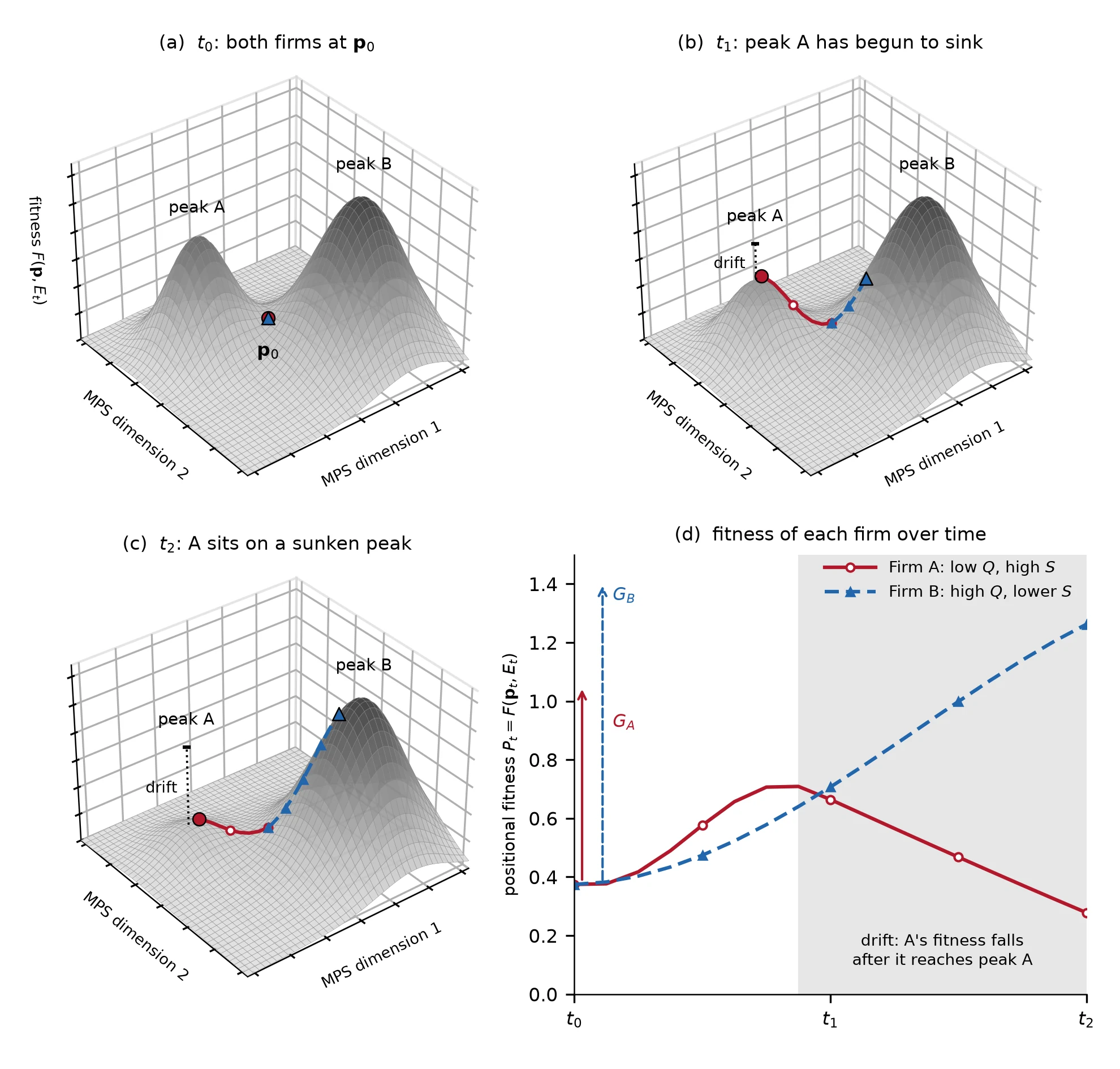
Proposition 7: Joint PDS complementarity
This proposition expresses the core claim directly: an organisation’s subsequent performance depends on the interaction of its positional fitness in a market problem space, the quality of the decisions that direct its movement from that position, and the speed with which those decisions are implemented. Positional fitness identifies the market-relative value of the firm’s current configuration; decision quality governs the selection and revision of strategic moves; and implementation speed governs how quickly those moves are realised. The three-way relationship is expected to be most visible when firms face material change and must repeatedly update their position.
P7: The positive association between positional fitness and subsequent performance will be strongest when decision quality and implementation speed are both high, particularly in environments with substantial market or technological dynamism.
Relation to Neighbouring Frameworks
PDS draws on several established frameworks, and its value depends on predicting something they do not. Table 2 summarises the closest neighbours, their central ideas and where PDS departs from them.
| Framework | Central idea | What PDS adds or predicts differently |
|---|---|---|
| OODA loop (Boyd; see Osinga, 2007) | Advantage comes from cycling through observe–orient–decide–act faster than an opponent, with orientation shaping what is observed and done | Separates decision quality from tempo and predicts that faster cycling lowers performance when decision quality is low (P4); judges tempo against market position, not only against a rival’s cycle |
| First-mover advantage (Lieberman & Montgomery, 1988) | Early entry can confer advantage through technological leadership, pre-emption of scarce assets and buyer switching costs, offset by free-rider effects and later resolution of uncertainty | Treats early movement as valuable only when it raises positional fitness: earlier is better when intended gain is positive and decision quality is high (P4, P6), so order of entry alone is expected to predict little |
| Red Queen competition (Barnett & Hansen, 1996) | Competition triggers learning that makes surviving organisations stronger rivals, which in turn intensifies competition for others | Represents rivals’ learning as environmental drift in a relative fitness function (Equation 5) and predicts that firms with strong positions but weak decision quality and speed lose fitness fastest where rivals move quickly (P7) |
| Strategic decision speed (Eisenhardt, 1989; Baum & Wally, 2003) | Fast strategic decisions can coexist with extensive information use and simultaneous alternatives, and faster decision-making has been linked to subsequent growth and profitability | Shifts attention from decision speed to implementation speed, and predicts that the payoff of either depends on decision quality and on the direction of movement (P4, P6) |
| Exploration and exploitation (March, 1991) | Adaptive processes tend to favour exploiting known alternatives over exploring new ones, gaining short-run returns at long-run risk | Recasts the choice as local versus distant movement in the market problem space and predicts that distant repositioning pays more as environmental drift and decision quality rise (P5) |
| Dynamic capabilities (Teece, 2007) | Sustained performance rests on sensing, seizing and reconfiguring as environments change | Separates positional state from capability, splits seizing into decision quality and implementation speed, and predicts their interaction instead of treating capability as one bundle |
| Strategic agility (Doz & Kosonen, 2010) | Agility rests on strategic sensitivity, leadership unity and resource fluidity | Treats these as possible antecedents of decision quality and implementation speed, and predicts that agility pays off only when movement is directed towards higher fitness (P6) |
| Continuous morphing (Rindova & Kotha, 2001) | In fast-changing markets, firms can sustain advantage by repeatedly transforming their form and function | Makes the direction of each transformation measurable (Equations 5 and 7) and predicts that frequent change without positive intended gain dissipates value |
| Decision quality (Spetzler et al., 2016) | A decision can be judged at the time it is made, on elements such as its frame, alternatives, information, values and reasoning, independently of its outcome | Adopts this process view (Table 1) and links decision quality to market position and implementation speed, predicting that its payoff rises with speed and dynamism (P4, P7) |
| Spatial competition and ideal points (Hotelling, 1929) | Firms choose locations in a product space relative to consumers and rivals, and consumers favour nearer offerings | Borrows the distance logic (Equation 2) but is dynamic and firm-centred: it asks how decision and implementation capabilities govern movement through the space, not where firms settle in equilibrium |
Three predictions recur across the table and distinguish PDS from any one of these frameworks taken alone. First, implementation speed and decision quality are complements, so faster implementation of low-quality decisions is expected to reduce performance (P4). Tempo-, timing- and decision-speed accounts acknowledge contingencies, but none makes the speed–quality interaction an explicit, measured term. Second, the value of speed depends on the ex ante direction of movement (P6), which order-of-entry and morphing accounts do not measure. Third, a strong current position combined with weak decision quality and slow implementation is expected to yield performance that decays faster in dynamic markets (P7), a pattern that static positioning accounts do not predict. If these interaction and direction effects fail to appear in data, PDS adds little beyond the frameworks it combines.
Boundary Conditions and Theoretical Qualifications
First, the framework is not intended to explain all sources of organisational performance. Industry structure, regulation, macroeconomic conditions, access to finance, organisational culture, leadership, human capital and exogenous shocks can influence outcomes independently of the PDS constructs. These factors belong in empirical models as controls, moderators or alternative explanations where theory warrants. The model is best understood as a parsimonious account of three related strategic capabilities and states, not a complete theory of the firm.
Second, the market problem space is not fixed. Customer preferences, technologies, institutional conditions and competitor offerings change over time, so the coordinates and fitness function are time-indexed. A position that was advantageous at may become disadvantageous at . This feature is central to the framework: positional fitness is dynamic, and environmental drift (Equation 5) can erode an unchanged position, which is why the value of a current position depends partly on the firm’s ability to detect and respond to change.
Third, the relationship between speed and performance is likely to be contingent and potentially nonlinear. In regulated, safety-critical or capital-intensive settings, speed may be constrained for good reasons. In other settings, rapid experimentation may be valuable because it accelerates learning. Kessler and Chakrabarti (1996), Cankurtaran et al. (2013) and Swink et al. (2006) all give reasons to avoid treating speed as a universal positive. The framework therefore distinguishes the capacity to move quickly from the judgement to move quickly when appropriate.
Fourth, decision quality is difficult to measure and may vary across decision classes. A firm may have strong processes for capital allocation but weak processes for product discovery or people decisions. Firm-level aggregation risks concealing these differences, which argues for decision-level measurement nested within business units and firms.
Fifth, performance is multidimensional. Financial returns, growth, customer outcomes, innovation outcomes, resilience and survival may not move together over a short period, so each study needs to specify its dependent variable and time horizon. Shareholder returns may be appropriate for some publicly listed firms but are not a universal normative measure of organisational success. In particular, the framework does not assume that maximising shareholder value is equivalent to maximising social welfare or stakeholder value.
Empirical Research Agenda
Measurement
Position is best measured at the product-market or strategic business-unit level, combining customer research, conjoint or discrete-choice estimates, competitor benchmarking, price-performance data and segment-level outcomes. Perceptual maps are useful descriptive tools, provided their dimensions and distances are justified. A positional index needs tests of convergent and discriminant validity and of sensitivity to segment weights.
Decision quality is measured from decision-level evidence recorded near the time of the decision, such as decision records, investment memoranda, documented alternatives or stress tests of a single option, forecasts, risk assessments and post-decision reviews, rated against Table 1 by raters blind to outcomes. Forecast calibration can be assessed separately over time.
Implementation speed is measured as the inverse of elapsed time between clearly specified milestones (Equation 6), distinguishing calendar time from active work time and reporting how paused or cancelled initiatives are treated. Target positions and intended gains (Equation 7) are recorded at authorisation. Innovation, decision and response speed remain separate measures unless a validated higher-order construct is demonstrated.
Directed positional change and performance are measured at lags suited to the mechanism. Directed change requires repeated positional measurement under a common fitness function (Equation 5). Short-term performance measures may include adoption, retention, revenue growth or time to break-even; longer-term measures may include profitability, market share, survival or sustained innovation. Multiple outcomes are preferable to a single collapsed index.
For publicly listed firms, archival proxies, such as announcement-to-execution intervals, distances in product or patent space and text-based indicators from disclosures, offer a route to large-sample tests once their validity against the primary measures has been established.
Research designs
A longitudinal panel design suits the framework’s dynamic logic, testing whether PDS constructs at predict directed positional change and performance at (Equations 9–11). Firm and time effects address some unobserved heterogeneity and common shocks but do not by themselves establish causality; reverse causality is a particular concern, since successful firms can afford better decision systems and faster implementation. A multi-level design with decisions and initiatives nested within business units and firms permits direct tests of decision quality and of Proposition 6 (Equation 12). Comparative case studies can help in early theory development, especially to examine how organisations construct their market problem spaces. Where causal identification is a goal, natural experiments, difference-in-differences designs or field experiments that vary decision procedures or implementation constraints are candidates, each with defensible identification assumptions. Predictive claims require out-of-sample evaluation, since a model that explains historical data is not necessarily a useful forecasting model.
Discussion
The PDS framework connects three questions that are often considered separately in organisational analysis: where is the firm positioned in relation to valuable market problems; how well does it decide which strategic moves to make; and how quickly can it translate those decisions into realised change? Its value lies in treating these as interdependent dimensions of adaptation instead of independent management slogans.
The spatial representation clarifies that a firm’s position is multidimensional and relational. It does not claim that every market can be reduced to a single objective coordinate system. Market spaces are constructed for a specified domain, and the value of a position depends on segment weights, competitor alternatives, the economics of serving customers and the broader environment. Fitness landscapes add the insight that organisational configurations are interdependent and that the path taken can constrain subsequent adaptation (Levinthal, 1997).
The decision component places a process-based account of decision quality between current position and subsequent movement. Inferring decision quality from outcomes alone is a mistake. A rigorous evaluation asks whether the decision was reasonable given the evidence, objectives, alternatives and constraints available at the time. This distinction is central to organisational learning, because systems that reward only favourable outcomes may reinforce luck and punish sound judgement under uncertainty.
The speed component captures the temporal dimension of adaptation. Identifying an attractive position or choosing a plausible direction achieves little if the organisation cannot implement the change before the opportunity disappears. Yet the literature does not support a universal claim that faster is better. The framework instead predicts that speed is valuable when it shortens the time between a sound decision and a market-relevant change in the right direction, without imposing excessive costs on quality, coordination or reliability.
The model also distinguishes a firm’s current positional advantage from its adaptive capacity. A firm can perform well because it occupies a favourable position, even if its decision and implementation capabilities are weak, but such performance may be fragile when the environment changes. Conversely, a firm with a weak current position may have the capabilities to reposition successfully. Empirical studies can therefore examine both performance levels and changes in performance, as well as the persistence of advantage over time.
The framework also has practical uses. For executives, strategy and transformation leads, boards and non-executive directors, private-equity operating partners and consultants, it offers a shared vocabulary for diagnosing an organisation’s position, the quality of its consequential decisions and the speed at which it implements them, and the checklist in Table 1 can structure decision reviews rated without knowledge of outcomes. Venture-capital and growth or private-equity investors could apply the same lens in due diligence: early-stage investments are largely bets on decision quality and implementation speed, made before much performance data exists, and the fast but poorly directed pattern in Figure 2 describes a recognisable risk. Quantitative applications are conditional. They would require operational proxies, such as announcement-to-execution time for implementation speed, distance in product or patent space for position, and text-based indicators drawn from disclosures for decision quality, together with evidence that these proxies predict performance. Until that evidence exists, such applications remain part of the empirical research agenda.
Theoretical Contribution
PDS is an integrative conceptual contribution and does not replace existing theories of strategy, decision-making or innovation. Its proposed value is a common dynamic architecture through which insights from these traditions can be connected. Positioning theory explains the value of a firm’s market configuration; strategic decision research explains how organisational actors select and revise commitments; dynamic capabilities and innovation research explain how organisations enact change under environmental dynamism. PDS links these elements through the idea of directed movement in a market problem space.
The framework also contributes a distinction between positional state, decision process, implementation speed and the direction of resulting change. This distinction matters conceptually and methodologically. It prevents the common conflation of current market success with decision quality, and of rapid activity with valuable movement. It also allows researchers to ask whether the constructs have independent, interactive or conditional relationships with performance, and it yields the specific predictions set out in Table 2.
Following established guidance on theory development, the framework identifies its focal constructs, specifies their relationships, states boundary conditions and derives propositions that can be subjected to empirical scrutiny (Corley & Gioia, 2011; Whetten, 1989). Its contribution will ultimately depend on whether empirical work shows explanatory or predictive value beyond existing constructs and models. The paper therefore presents PDS as a research programme, not as a validated forecasting instrument.
Limitations
The present paper has several limitations. First, it reports no original empirical data, and none of the propositions has been tested here. Second, the market problem space is a flexible construct whose usefulness depends on careful specification; without clear measurement rules, it could become too broad to falsify. Third, the framework is parsimonious by design and omits several potentially important determinants of performance. Fourth, the mathematical representations are formal organising devices, not a fully identified structural model; their empirical use requires validated measures, appropriate functional forms, adequate samples and defensible causal identification. Fifth, the comparison with neighbouring frameworks in Table 2 is necessarily brief and does not capture the full range of each literature. Finally, the relative importance of the PDS dimensions is likely to vary across industries, organisational forms and stages of development.
Conclusion
This paper has proposed the Position–Decision–Speed framework as a dynamic account of organisational adaptation and performance. Its core claim is that an organisation’s subsequent performance depends on the interaction of its positional fitness in a market problem space, the quality of the decisions that direct its movement from that position, and the speed with which those decisions are implemented. The framework formalises these relationships through a representation of positional movement, a model of directed positional change and a lagged performance model with interaction effects.
Being in a favourable position, making sound decisions and moving quickly are not independent prescriptions. Position without adaptive decision-making may become obsolete; decision quality without implementation may fail to produce change; and speed without a defensible strategic direction may accelerate waste. PDS offers a structure for examining these relationships and for developing empirical tests of when and how they matter. It remains a conceptual framework until those tests are conducted.
Declarations
Use of AI tools. AI tools assisted with drafting and editing this manuscript. The author reviewed all content and takes full responsibility for it.
Data availability. No data were generated or analysed for this conceptual paper.
Competing interests. The author is affiliated with Decision Intelligence, which publishes this working paper.
Suggested citation. Dunn, B. (2026). Position, decision, and speed: A dynamic framework for understanding organisational adaptation and performance (Decision Intelligence Working Paper No. 1). Decision Intelligence.
References
Barnett, W. P., & Hansen, M. T. (1996). The Red Queen in organizational evolution. Strategic Management Journal, 17(S1), 139–157. https://doi.org/10.1002/smj.4250171010
Barney, J. (1991). Firm resources and sustained competitive advantage. Journal of Management, 17(1), 99–120. https://doi.org/10.1177/014920639101700108
Baron, J., & Hershey, J. C. (1988). Outcome bias in decision evaluation. Journal of Personality and Social Psychology, 54(4), 569–579. https://doi.org/10.1037/0022-3514.54.4.569
Baum, J. R., & Wally, S. (2003). Strategic decision speed and firm performance. Strategic Management Journal, 24(11), 1107–1129. https://doi.org/10.1002/smj.343
Cankurtaran, P., Langerak, F., & Griffin, A. (2013). Consequences of new product development speed: A meta-analysis. Journal of Product Innovation Management, 30(3), 465–486. https://doi.org/10.1111/jpim.12011
Corley, K. G., & Gioia, D. A. (2011). Building theory about theory building: What constitutes a theoretical contribution? Academy of Management Review, 36(1), 12–32. https://doi.org/10.5465/amr.2009.0486
Day, G. S. (1994). The capabilities of market-driven organizations. Journal of Marketing, 58(4), 37–52. https://doi.org/10.1177/002224299405800404
Dean, J. W., Jr., & Sharfman, M. P. (1996). Does decision process matter? A study of strategic decision-making effectiveness. Academy of Management Journal, 39(2), 368–396. https://doi.org/10.2307/256784
Doz, Y. L., & Kosonen, M. (2010). Embedding strategic agility: A leadership agenda for accelerating business model renewal. Long Range Planning, 43(2–3), 370–382. https://doi.org/10.1016/j.lrp.2009.07.006
Eisenhardt, K. M. (1989). Making fast strategic decisions in high-velocity environments. Academy of Management Journal, 32(3), 543–576. https://doi.org/10.2307/256434
Elbanna, S., & Child, J. (2007). Influences on strategic decision effectiveness: Development and test of an integrative model. Strategic Management Journal, 28(4), 431–453. https://doi.org/10.1002/smj.597
Hotelling, H. (1929). Stability in competition. The Economic Journal, 39(153), 41–57. https://doi.org/10.2307/2224214
Kessler, E. H., & Chakrabarti, A. K. (1996). Innovation speed: A conceptual model of context, antecedents, and outcomes. Academy of Management Review, 21(4), 1143–1191. https://doi.org/10.5465/amr.1996.9704071866
Klein, G. (1998). Sources of power: How people make decisions. MIT Press.
Kolev, K. D., Dykes, B. J., Kang, S., Hughes-Morgan, M., & Ferrier, W. J. (2025). Fast or slow? A meta-analysis on the performance implications of decision, implementation, and response speed. Journal of Management Scientific Reports, 3(1), 40–67. https://doi.org/10.1177/27550311241291976
Levinthal, D. A. (1997). Adaptation on rugged landscapes. Management Science, 43(7), 934–950. https://doi.org/10.1287/mnsc.43.7.934
Lieberman, M. B., & Montgomery, D. B. (1988). First-mover advantages. Strategic Management Journal, 9(S1), 41–58. https://doi.org/10.1002/smj.4250090706
March, J. G. (1991). Exploration and exploitation in organizational learning. Organization Science, 2(1), 71–87. https://doi.org/10.1287/orsc.2.1.71
Nutt, P. C. (1999). Surprising but true: Half the decisions in organizations fail. Academy of Management Executive, 13(4), 75–90. https://doi.org/10.5465/ame.1999.2570556
Osinga, F. P. B. (2007). Science, strategy and war: The strategic theory of John Boyd. Routledge. https://doi.org/10.4324/9780203088869
Porter, M. E. (1996). What is strategy? Harvard Business Review, 74(6), 61–78.
Rindova, V. P., & Kotha, S. (2001). Continuous “morphing”: Competing through dynamic capabilities, form, and function. Academy of Management Journal, 44(6), 1263–1280. https://doi.org/10.2307/3069400
Spetzler, C., Winter, H., & Meyer, J. (2016). Decision quality: Value creation from better business decisions. Wiley. https://doi.org/10.1002/9781119176657
Swink, M., Talluri, S., & Pandejpong, T. (2006). Faster, better, cheaper: A study of NPD project efficiency and performance tradeoffs. Journal of Operations Management, 24(5), 542–562. https://doi.org/10.1016/j.jom.2005.09.004
Teece, D. J. (2007). Explicating dynamic capabilities: The nature and microfoundations of (sustainable) enterprise performance. Strategic Management Journal, 28(13), 1319–1350. https://doi.org/10.1002/smj.640
Whetten, D. A. (1989). What constitutes a theoretical contribution? Academy of Management Review, 14(4), 490–495. https://doi.org/10.5465/amr.1989.4308371
How to cite
Dunn, B. (2026). Position, decision, and speed: A dynamic framework for understanding organisational adaptation and performance (Decision Intelligence Working Paper No. 1). Decision Intelligence. https://decisionintel.co/research/position-decision-speed