How it works
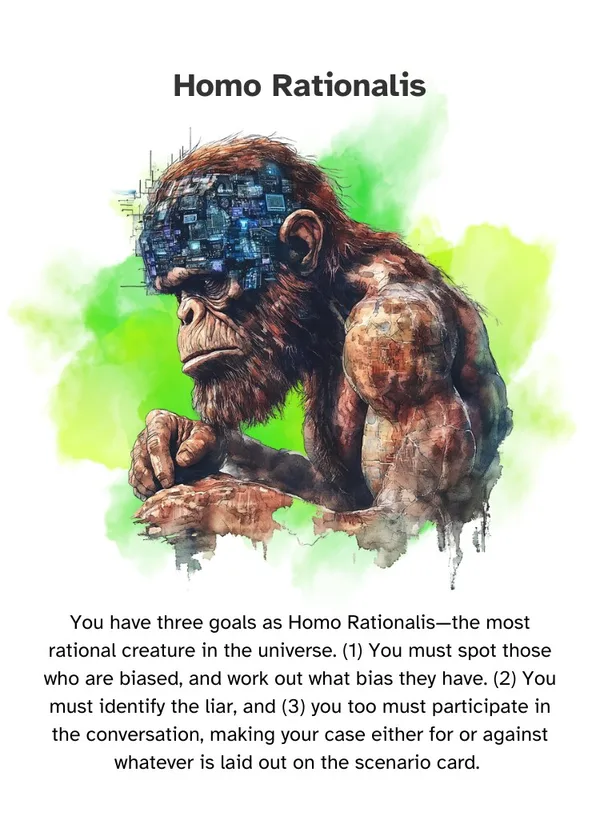
Homo Rationalis is a simple yet powerful game designed to sharpen team decision-making by helping individuals become more familiar with, aware of, and resistant to cognitive biases and logical fallacies.
The game works by giving players the chance to simulate common cognitive errors. This helps build recognition through elaborative learning—a method known to enhance recall—and trains players to identify biases and fallacies in real time.
As a bonus, it also shifts attention toward the core of an argument, reducing distractions from peripheral points that don’t meaningfully affect the quality of a decision.
Though the rules are straightforward, some biases can be challenging to simulate. The guide below explains the mechanics of the game in detail.
Setting up
- 01
To make things easier, the first thing you’ll want to do is organise the cards into separate stacks. The first and largest pile will be all the cognitive bias and logical fallacy cards—put all of these together.
- 02
Next, the scenario cards, labelled accordingly, can be placed in their own pile.
- 03
After that, place the for and against cards in their own stack; these can be easily identified by the red line on the back of the cards.
- 04
Lastly, place the actor cards together. These will have the same back as the cognitive bias cards, but on the front, will have either a Homo Rationalis character, a Liar card, or a Moderator card.
Reading a bias card
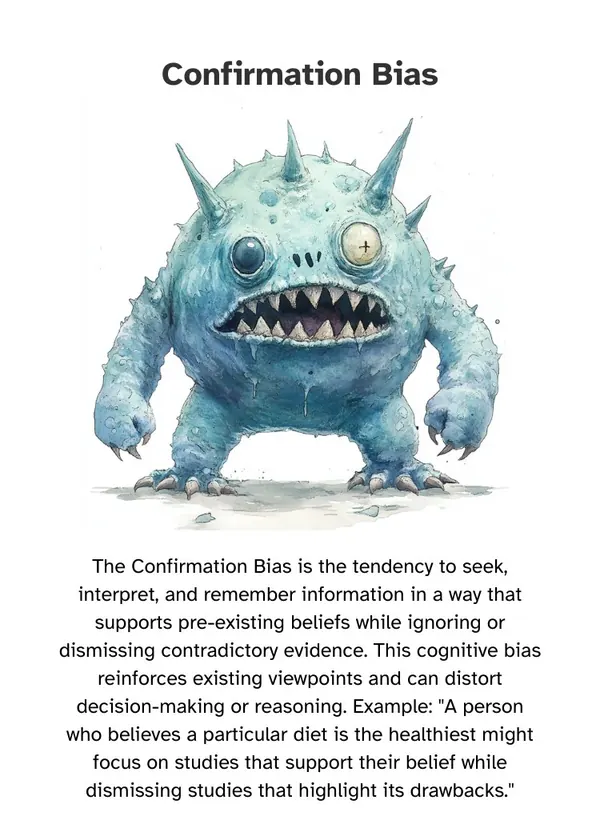 1234
- 1Bias name — Confirmation Bias
- 2Illustration
- 3What it is — what the bias is and how it bends a decision
- 4Example — the bias in everyday life
Biases Bank
At the beginning of each game, you will draw 10 bias cards which are potentially going to be at play. Each bias will be turned face up so everyone can see them, and players are given a few minutes to go through each one and become familiar with the bias and what it might look like. If you want to research the biases a little or seek clarification about them—this is the point to do it.
This exposure step is to psychologically prime the players to be on the lookout for the biases and also makes the game easier for first-time players. The bias cards are then turned over, face down, and shuffled.
One Bias card is then selected at random and placed into a deck with the Liar, Homo Rationalis, and Moderator cards. There should now be one card for every player at the table. The remaining bias cards can be put aside; they are no longer required.
Advanced Mode
As players become more familiar with the game, we encourage teams to skip the priming step entirely, as the number of biases people become familiar with increases. To play with no priming is difficult, but more authentically represents how conversations occur in the real world.
Player Cards
Next you want to distribute the player cards; in every game, you need at least 3 players.
- One player will have a Bias card.
- At least two players will have a Homo Rationalis card (9 max)
- One player may have a liar card (optional)
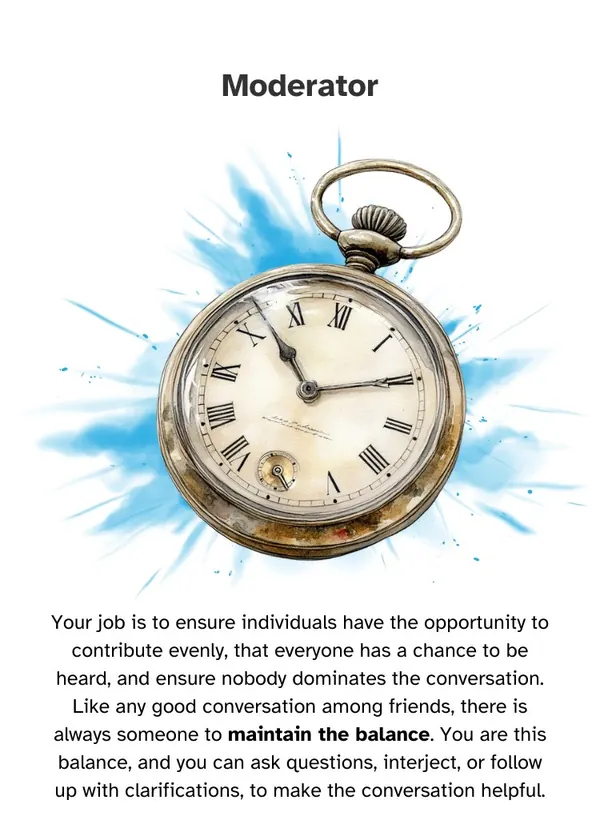
- And one player may be given a moderator card (optional)
The liar card provides an additional dimension of the game (explained in a moment) and a moderator card is used for larger games, where someone is elected an official to keep track of the conversation and to elicit input and dialogue from the quiet introverts among us. Games can be played without these cards for smaller groups. An example game: To play with 2 Homo Rationalis, one Bias, and a Liar and a Moderator will make the game 5 players.
Scenarios
Next, a scenario card is drawn. These cards outline the topic of conversation. This is the main element you will all be discussing. The included scenarios are designed to be divisive—people will agree or disagree with the cards. You can also choose an open scenario, where you simply decide on what you’d like to discuss on your own. These open scenarios can be good to work on actual scenarios at play within the team. It might be a decision you are trying to work on, or a project that is currently problematic.
For or Against
Next each player draws cards either for or against the scenario. This essentially puts people into teams. As long as there is some balance between the teams it is not essential for there to be an exactly equal number either side, so long as there are enough people in either camp to foster a decent discussion. While players may feel more emotionally connected to one side or the other, arguing for something you would typically argue against has a cognitive benefit—it encourages seeing arguments from an alternative perspective which can make you less susceptible to your own biases. Therefore, it’s encouraged to keep the for / against card you have drawn, even if normally, you might disagree with the position.
Play
Now each player will take a turn making their case for or against the scenario. The moderator will facilitate the conversation and entice everyone to speak for roughly the same amount of time. During this conversation, anyone can ask questions, follow up, enquire more, and speak freely. Keep it informal and natural. For the Homo Rationalis the goal is to identify the liar and the bias. If at any time the Homo Rationalis feels they have found the liar or the biased, they simply say Stop and make their identification.
Finding the liar
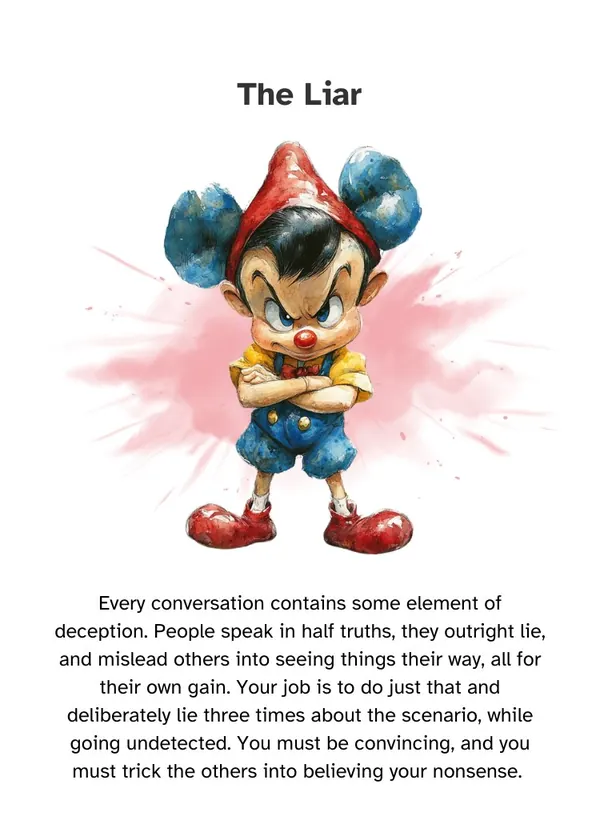
To correctly identify the liar, once a player has stopped the conversation, they must first state who the liar is, and what they lied about. If they get this correct, the liar identifies themselves (I am the liar) and is removed from the game. If they have been falsely accused, the person states they (are not the liar) and the accuser is removed from the round. If the accuser correctly identifies the liar, but gets what they lied about wrong or only gets some of the lies correct and not others (the liar will lie three times), the liar may be misleading and say they are not the liar and continue playing. If you successfully eliminate the liar, you are awarded 3 points.
Why is there a liar? In everyday conversations, people frequently mislead, speak in mistruths or half-truths. Being able to detect such deception is therefore an advantage in the real world. It is not designed to encourage a distrust in humanity, but to simply reflect the nature of life.
Finding the biased
Finding a biased player once a game is stopped is as simple as identifying the player who is biased, and identifying the bias. If they correctly identify this the accuser is awarded 1 point. If they incorrectly accuse someone, then the accuser is removed from the round. Anyone removed from a round by getting an accusation incorrect must remain silent for the rest of the round.
How to win
If there are no moderators in the game, then the first player to reach 8 points wins the game. You may play as many rounds as you like.
With moderators
If you are playing with moderators, the game ends when every player at the table has had a turn at being the moderator. The player with the most points wins.
Moderators
Each game should run for about 2–3 minutes per player. So if there are 4 players that means the game should be set to a maximum of 12 minutes. If the liar and the biased player go undetected and the game ends, the liar will be awarded 1 point, and the biased player will be awarded 2 points. If the moderator believes the biased has incorrectly represented the bias, or not demonstrated it sufficiently, they may, at their discretion, award 1 point to each Homo Rationalis player. Moderators cannot score, they are a non-participant. When a round is finished, the moderator passes the moderator card to the person on their left.
| Accuser — Correctly names the liar and what they lied about | 3 |
|---|---|
| Accuser — Correctly names the biased player and the bias | 1 |
| Liar — Goes undetected when the game ends | 1 |
| Biased player — Goes undetected when the game ends | 2 |
| Each Homo Rationalis player — Moderator decides the bias was poorly represented (at their discretion) | 1 |
No moderators: first to 8 points wins. With moderators: most points once everyone has moderated. Moderators don't score.
What does Homo Rationalis do?
The game has a few cognitive benefits. Firstly, it helps teams become more familiar with biases and logical fallacies and how they might appear in a regular conversation, which helps them be on the lookout—it’s a kind of pre-bunking, with the goal of inoculating them from biases in the real world. Secondly, by role-playing biases, it helps individuals learn them better because the act of simulation leverages more elaborate training methods, which is more effective than simply watching a video or reading about them in a book. Thirdly, and this is the best part, it encourages teams to really pay deep attention in conversations more broadly, and listen to the arguments, not the individuals. This has wide-ranging effects on team performance, and promotes a more active listening culture.