Disagree Better
Eight prompts for more constructive workplace debate.
When a discussion gets stuck, start with the question that would help most.
Download printable poster (PDF)A4 · colour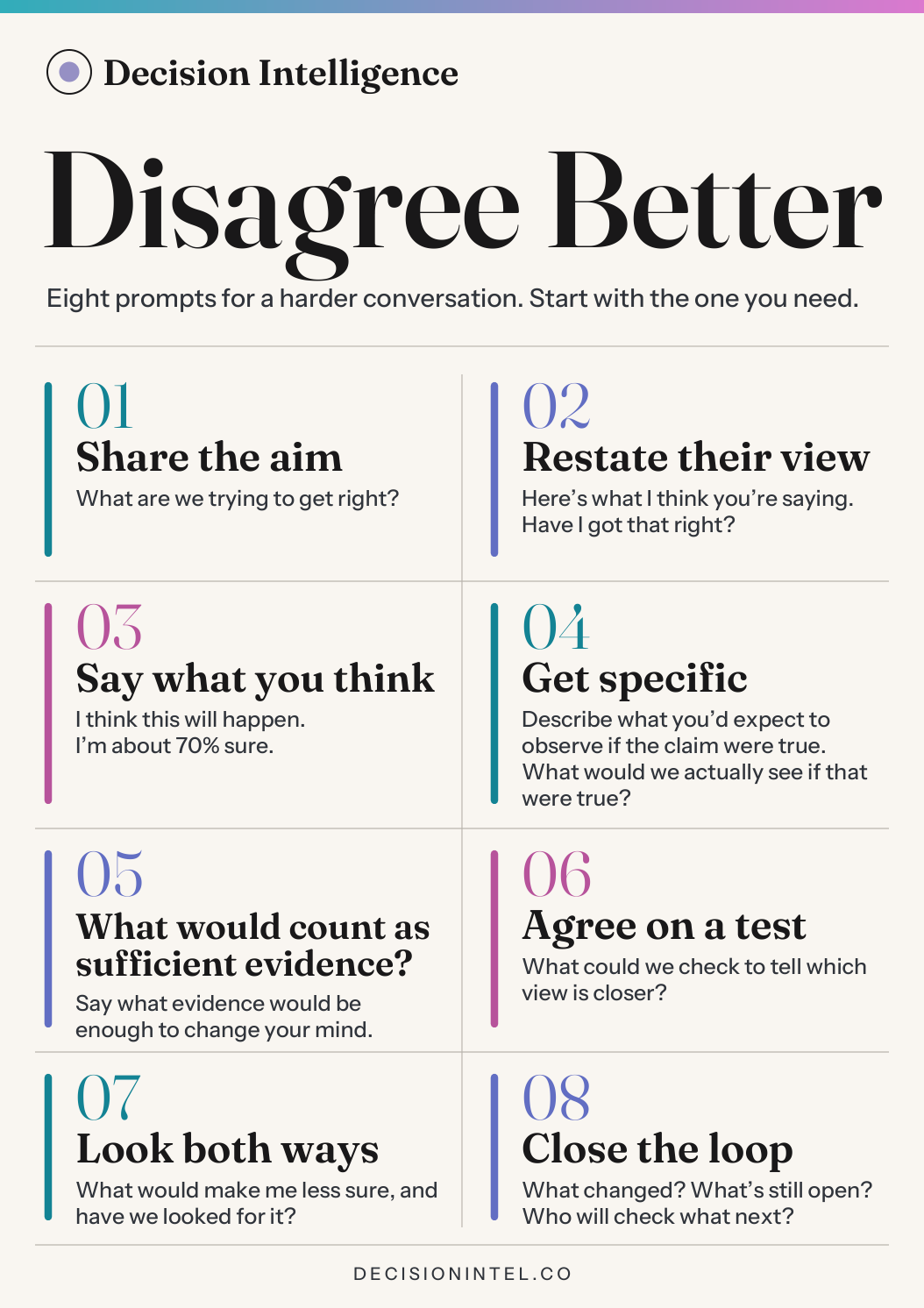
Why it helps
Debating ideas and working through disagreements can be hard, especially when people care about the outcome. These eight simple steps help teams clarify where they disagree, work out what evidence would help and decide what to do next. Print the free poster and keep it handy as a reminder.
Eight prompts to use in the room
Share the aim
Agree on what you’re trying to work out.
“What are we trying to get right?”
Restate their view
Give them a chance to correct your understanding.
“Here’s what I think you’re saying. Have I got that right?”
Say what you think
State your claim and how sure you are. Use a percentage if it helps.
“I think this will happen. I’m about 70% sure.”
Get specific
Describe what you’d expect to observe if the claim were true.
“What would we actually see if that were true?”
What would count as sufficient evidence?
Say what evidence would be enough to change your mind.
“If we found this, I’d rethink my position. What would change yours?”
Agree on a test
Pick a check that could distinguish the two explanations.
“What could we check to tell which view is closer?”
Look both ways
Seek evidence that would weaken your own view.
“What would make me less sure, and have we looked for it?”
Close the loop
Give the next check an owner.
“What changed? What’s still open? Who will check what next?”
Do
- Treat arguments as tools for working out what’s true or what will work.
- Separate what you saw from what you concluded.
- Let people rephrase if their first try missed.
- Notice when something feels off, and say so.
Don’t
- Hold people to the worst version of their point.
- Invent motives for the other person.
- Pretend your plan has no costs, or that you can’t be wrong.
- Get stuck debating who’s biased.
Ideas drawn from LessWrong contributors Eliezer Yudkowsky, Duncan Sabien, Scott Alexander and Bryan Caplan, and from the Center for Applied Rationality (CFAR).